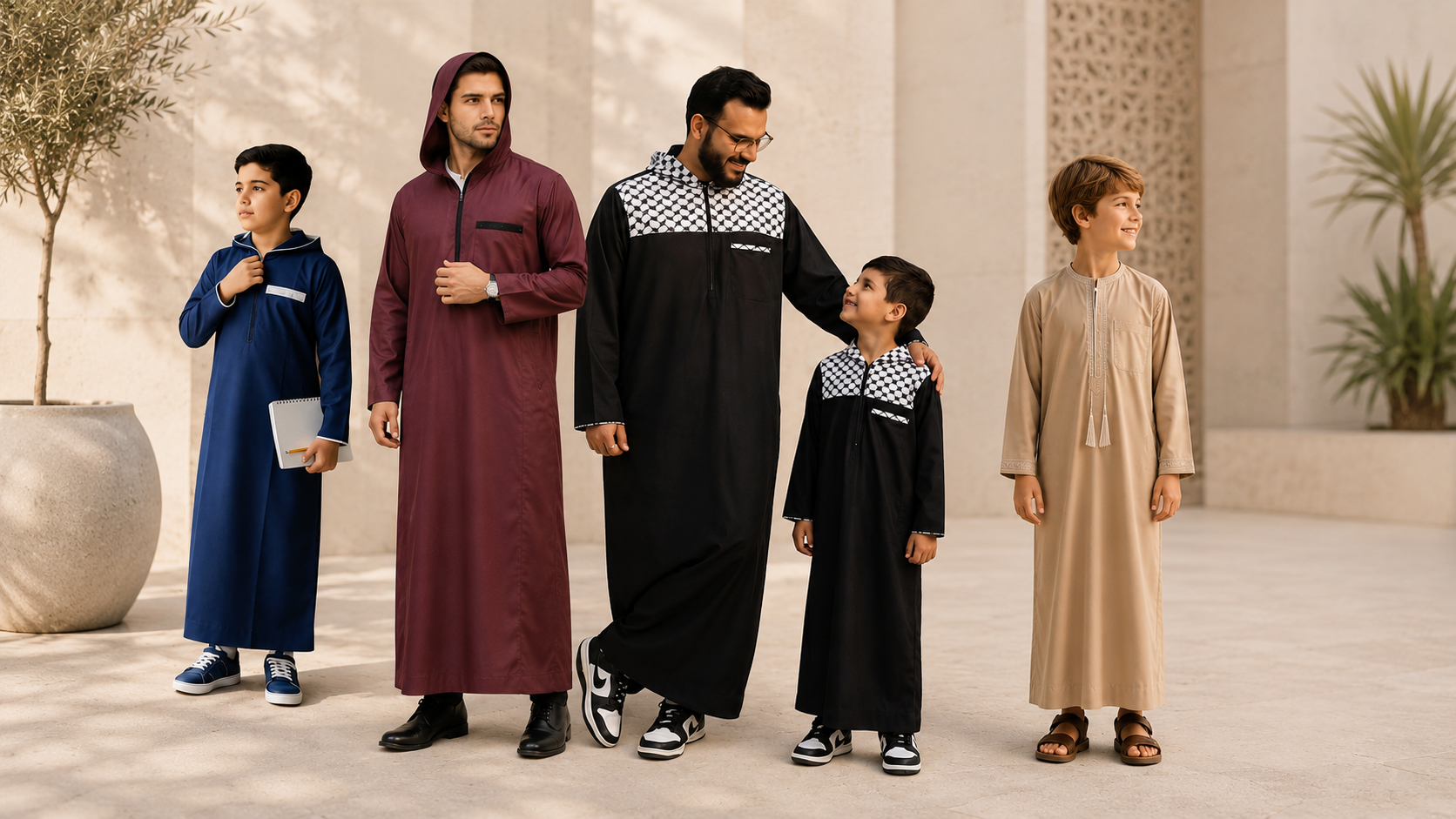
What Is a Thobe? Meaning, Styles & How to Wear One
What is a thobe? A thobe is a long, loose, ankle-length robe with sleeves, worn by men across the Arab world, parts of Africa and South Asia, and by Muslim men worldwide. It is cut wide through the body so it skims rather than clings, it covers from the neck to the ankle, and it is worn as ordinary clothing rather than as a costume. If you have seen men at a mosque on a Friday in a full-length white garment, you have seen a thobe.
This guide covers the meaning of the word, where it comes from, how to pronounce it, the regional variations, which fabrics suit which season, how a thobe should fit and when men actually wear one.
Thobe meaning and where the word comes from
The word comes from the Arabic thawb (ثوب), which simply means "garment" or "cloth." It is not a brand, a style name or a modern invention - it is the ordinary Arabic word for a piece of clothing, which over time attached itself to this particular long robe.
Thobe vs thawb is therefore not a real distinction. They are two spellings of the same Arabic word. Thawb is the closer transliteration; thobe is the spelling that took hold in English. You will also see thoub and tobe. All of them refer to the same garment.
Thobe pronunciation
In English it is usually said "thobe" - rhyming with "robe," with the soft th of "think" at the front. In Arabic it is closer to "thawb", with the vowel sounding like the "ow" in "grow" said quickly. Either is understood. Nobody will correct you at the door of a masjid.
What is a thobe called elsewhere?
The same basic garment carries different names depending on where you are, and the cut shifts slightly with each:
- Thobe / thawb - Saudi Arabia and much of the Gulf and Levant
- Kandura - the United Arab Emirates and Oman
- Dishdasha - Kuwait, Oman, Iraq
- Jubba - common among South Asian and Turkish communities
- Gandoura - North Africa, often shorter-sleeved and looser
- Boubou or jalabiya - West and North Africa, wider and more flowing
These overlap heavily and are often used interchangeably by sellers. We break down the actual construction differences in our guide to thobe vs jubba vs dishdasha vs kandura.
Is a thobe religious? The honest answer
This question comes up constantly, and it deserves a careful answer.
Islam requires modest dress. For men, the widely taught standard is that the body from the navel to the knee is covered, that clothing is not transparent or so tight that it outlines the body, that it is not worn out of arrogance, and that men do not dress in imitation of women. That is the religious requirement. It says nothing about a specific garment.
The thobe is one traditional expression of that standard, and a very good one - it is loose, opaque and covering by design. It also carries a Sunnah dimension for many Muslims, since long, loose garments of this kind were the dress of the Prophet Muhammad (peace be upon him) and of the society he lived in, and many wear a thobe partly out of love for that example.
But a man in modest trousers and a long shirt has met the requirement. Wearing a thobe is a cultural and devotional choice, not an obligation, and it is worn by Arab Christians and non-Muslims in some regions too. Understanding that keeps the garment in its right place: meaningful clothing with real history behind it, not a uniform and certainly not a costume.
Why do Muslim men wear thobes?
The practical reasons are as real as the spiritual ones. A thobe is loose enough to be genuinely comfortable in heat, it makes prayer movements easy in a way that fitted trousers do not, it covers properly without any thought, and it looks formal without needing a suit. Add cultural continuity and the connection to the Sunnah, and you have a garment people keep choosing after fifteen hundred years.
A short history
Long, loose, unstructured robes are among the oldest forms of clothing on earth, and versions of them appear across the Middle East, North Africa and Central Asia long before Islam. What we now call a thobe grew out of that broader tradition of desert dress, where a full-length robe protected the wearer from sun, heat and blowing sand while allowing air to circulate underneath.
Its modern shape was shaped by contact with tailored Western clothing in the twentieth century. The collar, the buttoned placket, the cuffed sleeve and the chest pocket that are standard on a Saudi-style thobe today are relatively recent refinements grafted onto a very old silhouette. Emirati and Omani styles kept a collarless neckline and, in the Emirati case, the decorative tarboush tassel at the neck.
Regional styles at a glance
| Style | Collar and neckline | Distinguishing detail |
|---|---|---|
| Saudi | Shirt or mandarin collar, buttoned placket | Crisp, structured, cuffed sleeves, chest pocket |
| Emirati (kandura) | Collarless round neck | The tarboush, a braided tassel at the neckline |
| Omani | Collarless with a stand | Similar to Emirati, often a longer tassel |
| Moroccan / gandoura | Open or embroidered round neck | Wider cut, often short-sleeved, decorative trim |
| South Asian jubba | Mandarin or open collar | Slightly slimmer body, often side pockets |
| Turkish | Mandarin collar | Heavier fabrics, often layered with a coat |
If a specific look appeals to you, browse Emirati thobes with tarboush or Moroccan thobes and gandoras to see the differences side by side.
Shop This Look


Fabrics by season
- Summer - lightweight cotton, cotton-linen and light poly-cotton. Breathable, and light colors reflect heat. Traditional white is genuinely functional, not just customary.
- Spring and autumn - standard poly-cotton blends. The all-round choice: crisp, low-maintenance, holds a line without a daily iron.
- Winter - heavier weaves and wool blends, which matter in the northern US where a Friday walk from the parking lot is a real consideration. Layer a Turkish coat or a warm undershirt beneath.
The quickest quality check on any fabric is to hold it toward a window. If light passes through clearly it is too thin, which defeats the purpose of the garment.
How a thobe should fit
A thobe is not meant to be fitted, but it is not meant to be shapeless either. Three things matter:
- Length. The hem should sit at or just above the ankle bone - covering the ankle, clear of the floor. It should never drag. Many Muslim men deliberately keep the hem above the ankle following the Sunnah relating to the isbal.
- Shoulder. The shoulder seam should sit at the edge of your shoulder, not halfway down your arm.
- Body. Loose enough to sit cross-legged and to bow and prostrate in prayer without pulling anywhere.
This is why sizing matters so much. Our thobes are sized by length in inches - 52 to 62 for men, with a separate chest size, and 18 to 50 for boys - so you choose your hem rather than guess it. Measure from the shoulder point straight down to the ankle bone and use our adult thobe size guide to confirm.
A Note on the Ankle-Length Rule
The guidance to keep the hem at or above the ankle traces back to hadith warning against garments that drag on the ground out of pride, a practice historically associated with arrogance and status display. Many Muslim men today follow this as a point of Sunnah regardless of the original context, and it has the practical side benefit of keeping the hem out of puddles, prayer-hall carpets and bicycle chains. If you are unsure where your own hem should sit, ankle bone visible with the foot flat on the ground is the standard reference point tailors and sellers use.
Caring for a First Thobe
A new thobe benefits from one cold wash before the first wear, which removes sizing chemicals left over from manufacturing and softens the fabric against the skin. After that, wash cold and inside out, skip fabric softener on poly-cotton blends since it reduces breathability over time, and hang to dry rather than folding into a drawer — a hung thobe needs little to no ironing, while a folded one usually needs a full press before it looks presentable again.
How to wear a thobe
Underneath
A plain cotton undershirt and loose shorts or a sirwal. The undershirt is not optional with white or light fabric - it keeps the thobe opaque and absorbs perspiration.
On your head
A kufi or topi is the most common pairing, simple and appropriate everywhere. In Gulf dress a ghutra or shemagh held by an igal is traditional. Bare-headed is entirely acceptable too.
On your feet
Leather sandals are the classic, and easy to slip off at the masjid. Plain loafers or dress shoes work for formal occasions, and clean sneakers are unremarkable for everyday wear. Keep socks plain and dark, since they will be seen at prayer.
When men wear a thobe
- Every day - in the Gulf, ordinary daily dress including at work. In the US, more often at home, for errands and around the community.
- Jumu'ah - the Friday prayer is the single most common occasion in America. A clean, well-pressed thobe in white or a soft neutral is the standard.
- Eid - the day for the good one: embroidery, contrast trim, a heavier fabric, often matching thobes for fathers and sons.
- Weddings and celebrations - formal thobes in richer fabrics, sometimes with a bisht layered over the top.
- School and madrasa - plain, hard-wearing thobes as uniform, covered in our Islamic school uniform guide.
Buying your first thobe
Start with one plain thobe in white or a neutral, in a poly-cotton blend, at your measured length. Wear it for a few weeks before buying anything embroidered - you will learn quickly which length and collar you actually like. From there, most men settle into two or three everyday thobes plus one occasion piece.
Shop This Style — Men's White Thobe – Mandarin Collar Daily Wear ($49)
Ours start at $49 for men's thobes and $39 for boys' thobes, with any three at $99 applied automatically at checkout. Standard US shipping is free on every order from our Chicago-area warehouse in Glendale Heights, Illinois, and most orders arrive in four to six business days. If you are still comparing sellers, our guide to the best thobe brands in the USA lays out what to check before you buy anywhere.

Frequently asked questions
Do I need a different thobe for prayer specifically?
No separate garment is required. Any clean, modest thobe is appropriate for salah, though many men keep one plain, well-pressed thobe specifically for Jumu'ah and daily prayer to avoid arriving at the masjid in whatever was worn around the house or at work that day.
What is a thobe in simple terms?
A thobe is a long, loose robe with sleeves that reaches the ankles, worn by men. It covers the whole body, is cut wide so it does not cling, and is worn as everyday and formal clothing across the Arab world and by Muslim men everywhere.
Is there a difference between a thobe and a thawb?
No. They are two English spellings of the same Arabic word, thawb, meaning garment. Thobe is the more common spelling in English; thawb is the closer transliteration. The garment is identical.
Can non-Muslims wear a thobe?
Yes. A thobe is cultural dress with religious significance for many wearers, not a sacred object, and it is worn by non-Muslims in the regions where it originates. Wear it with respect - clean, properly fitted, and for a real reason rather than as a novelty - and it is welcomed.
What do you wear under a thobe?
A plain cotton undershirt and loose shorts or a sirwal. With white or light-colored fabric an undershirt is important, as it keeps the thobe from becoming see-through in bright light.
How long should a thobe be?
It should reach the ankle bone or sit slightly above it, never touching the floor. Measure from the shoulder point straight down to the ankle and choose that length in inches. Many men keep the hem just above the ankle in keeping with the Sunnah.
Is a thobe hot to wear in summer?
Less than you would expect. The loose cut lets air move around the body, and light-colored fabric reflects sun rather than absorbing it, which is exactly why the garment developed in hot climates. Choose a lightweight cotton or cotton-linen thobe for the warmest months.