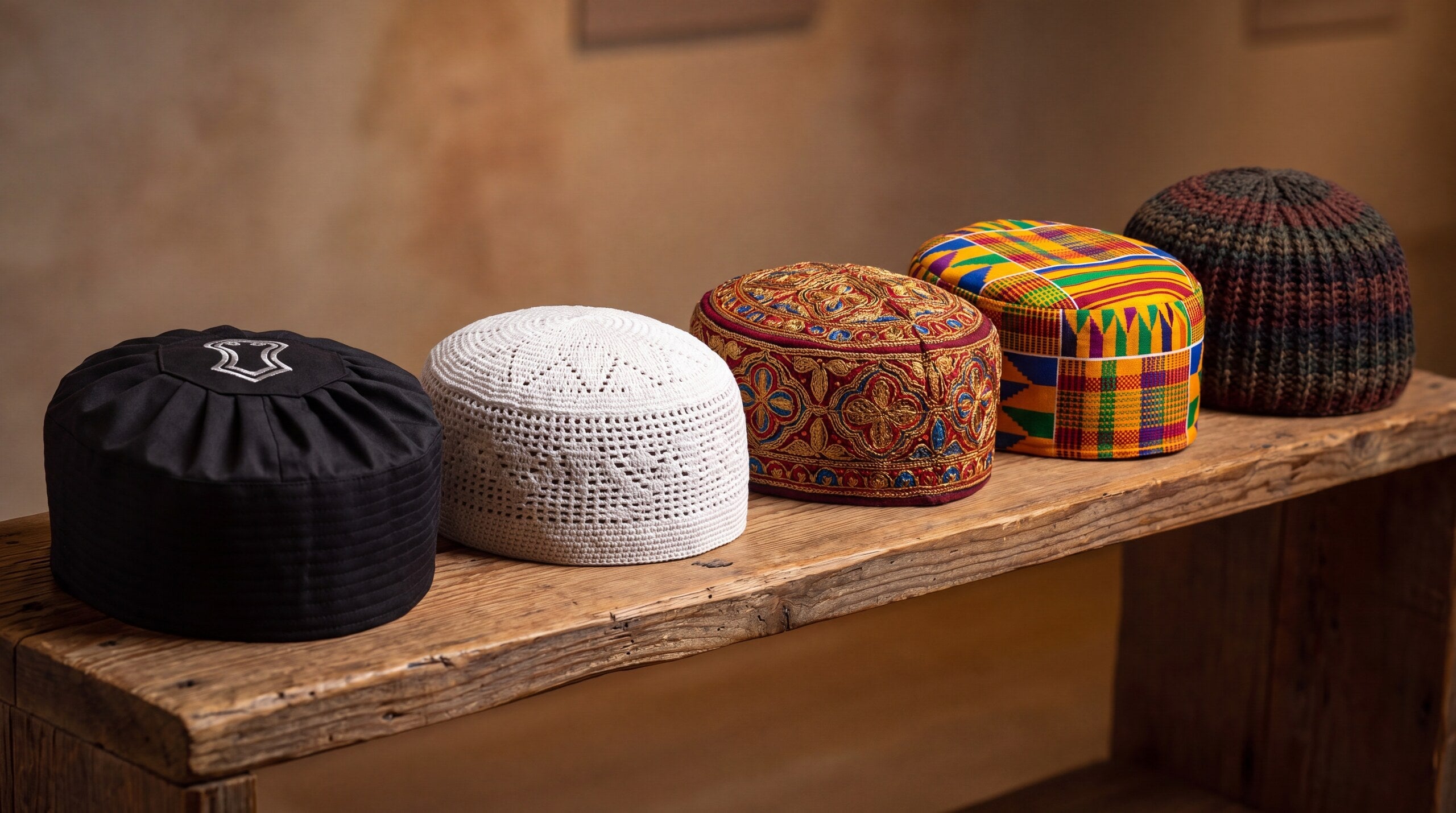
The History of the Kufi: From the Prophet's ﷺ Time to American Streets
It sits on millions of heads at every Jumu’ah, costs less than a pizza, and carries fourteen centuries of history. The kufi may be the most underestimated garment in the Muslim wardrobe — so here’s its remarkable story, from the Prophet’s ﷺ era to the streets of Chicago and Houston, and why the humble cap deserves more respect than it gets.
The Beginning: Head Covering in Early Islam
Covering the head was the near-universal norm of dignified dress in seventh-century Arabia — the Prophet ﷺ and his Companions wore head coverings including caps (qalansuwa) and turbans wrapped over them. While scholars discuss the precise rulings, the cultural through-line is unbroken: across Muslim civilization, a covered head signaled respect, especially in prayer. That cap — the taqiyah in Arabic — is the direct ancestor of every kufi sold today. It wasn’t ceremonial in the way we might think of formalwear now; it was simply how a man dressed, every day, for prayer and beyond.
A Thousand Years of Local Genius
As Islam spread, every region reinvented the cap in its own image: the embroidered rigid caps of Central Asia and the subcontinent (where it became the topi — yes, our namesake), the crocheted styles of Southeast Asia, the Ottoman variations, and — crucially for the American story — the magnificent brimless caps of West Africa, where the kufi crowned scholars, elders, and royalty in Mali, Songhai, and beyond. The word "kufi" itself carries that African lineage, likely tracing back to Kufa, the early Islamic city in present-day Iraq, filtered through West African trade routes and scholarship networks that carried both cloth and knowledge across the Sahara.
The American Chapter
The kufi’s US story is unique: it arrived twice. It came with enslaved West African Muslims centuries ago — a detail often left out of American history entirely — and returned in the twentieth century through two currents at once: the African-American Muslim revival, where figures from Malcolm X’s era onward made the kufi a symbol of dignity and self-definition, and immigrant communities from South Asia, Africa, and the Arab world carrying their regional styles. In America these traditions merged: today’s masjid features Senegalese-style kufis, Pakistani topis, and crocheted caps in the same saff — possibly the most diverse kufi landscape on earth, all under one roof, all valid, all part of the same fourteen-century thread.
Shop This Look


The Streetwear Era
The newest chapter is being written right now: a generation of young American Muslims wearing the kufi beyond the masjid — with hooded thobes, with denim jackets, on campus and in team meetings — as everyday identity rather than occasion-wear (styling guide here). What began as seventh-century adab is now also twenty-first-century self-expression, and both layers are true at once: the same cap that marked respect in the Prophet’s ﷺ masjid marks identity in a college lecture hall today.
How to Choose a Kufi That Fits Your Head, Not Just Your Style
A surprising number of men wear a kufi that’s slightly too tight or too loose and never notice until it slides off mid-sujood. A few practical notes worth knowing: structured, quilted kufis (like the Chevron or Barakah styles) hold their shape best and suit brothers who want a crisp, formal look; softer knit and crocheted styles flex more and are the most comfortable for all-day wear; and pattern-embroidered kufis like the Naqsh style work beautifully as a statement piece for Jumu’ah or Eid, while a plain black or navy kufi is the one you’ll reach for daily. Most men end up owning three or four — one structured, one soft, one patterned, one backup that lives in the car or backpack.
Shop This Style — Men’s Naqsh Pattern Kufi ($17.00)
Why "The Topi Wala"?
In Urdu, a topi wala is literally "the cap seller" — the neighborhood figure every South Asian Muslim community knew, the man whose stall or shop was where every boy got his first kufi before Eid. We took the name because the humble cap is where our story starts too: heritage you can wear, starting at $17.

Carry the history forward — explore the kufi collection: classic styles, modern colors, 3 for $45, shipped across the USA.